
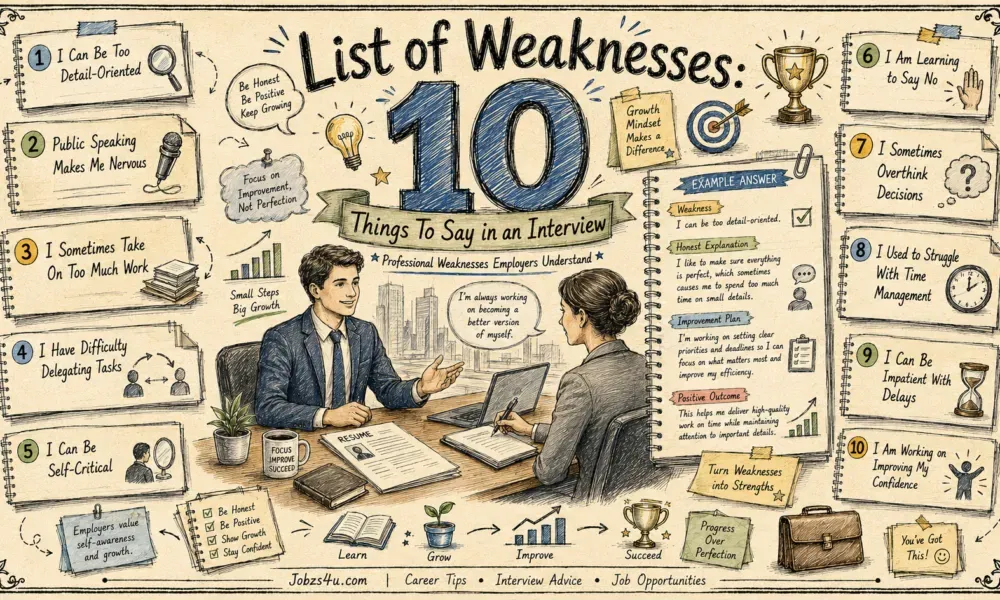
List of Weaknesses: 10 Things To Say in an Interview
How to Write a CV That Gets You Hired in the Gulf
A step-by-step guide to create a professional CV that stands out to employers and recruiters across the Gulf countries.

Job interviews often include the common question, “What is your greatest weakness?” Many candidates feel nervous about this question because they want to be honest without damaging their chances of getting hired. The best answer is professional, truthful, and focused on improvement.
Employers do not expect perfect candidates. They want to see self-awareness, honesty, and a positive attitude toward learning. Below are 10 professional weaknesses you can mention in an interview with strong example answers.
1. Being Too Detail-Oriented
Sometimes, focusing too much on small details can slow down work.
Example Answer: “I sometimes spend too much time checking details because I want my work to be accurate. I am improving this by setting time limits and focusing on both quality and efficiency.”
2. Difficulty Delegating Tasks
Some people prefer doing tasks themselves because they want to make sure everything is done correctly.
Example Answer: “I sometimes find it difficult to delegate tasks because I like to take ownership of my work. However, I am learning to trust team members and share responsibilities more effectively.”
3. Public Speaking Nervousness
Many professionals feel nervous when speaking in front of a group.
Example Answer: “Public speaking has been a challenge for me, especially in large groups. I am working on this by taking part in meetings and presentations whenever I get the chance.”
4. Taking on Too Much Work
Being helpful is good, but accepting too many tasks can affect time management.
Example Answer: “I sometimes take on too much work because I want to help the team. I am improving by learning how to prioritize tasks and manage my workload better.”
5. Limited Experience with Certain Software
No candidate knows every tool, especially when technology keeps changing.
Example Answer: “I have limited experience with some specific software, but I am a quick learner. I am currently improving my skills through practice and online learning.”
6. Being Self-Critical
Some employees judge their own work too strictly, even when they are performing well.
Example Answer: “I can be too critical of my own work at times. I am learning to recognize my progress while still looking for ways to improve.”
7. Hesitation to Ask for Help
Trying to solve problems alone can be positive, but waiting too long to ask for help may waste time.
Example Answer: “I sometimes try to solve problems on my own for too long before asking for help. I am learning that asking questions at the right time can improve results and save time.”
8. Difficulty Saying No
Helpful employees may sometimes accept more work than they can manage.
Example Answer: “I sometimes find it difficult to say no when someone needs help. I am working on balancing teamwork with realistic workload management.”
9. Impatience with Slow Processes
People who like fast results may feel impatient when tasks move slowly.
Example Answer: “I prefer working efficiently, so I can sometimes feel impatient when processes are slow. I am learning to be more patient and understand the importance of each step.”
10. Limited Confidence in New Situations
New tasks or environments can sometimes feel challenging at first.
Example Answer: “When I face a completely new situation, I may feel less confident at the beginning. However, I adapt quickly by learning, asking questions, and gaining practical experience.”
Tips for Talking About Weaknesses in an Interview
- Be honest but professional.
- Choose a weakness that does not stop you from doing the job.
- Explain what you are doing to improve.
- Keep your answer short and positive.
- Show that you are willing to learn and grow.
Common Mistakes to Avoid
- Do not say you have no weaknesses.
- Do not choose a weakness that is essential for the job.
- Do not give overly personal answers.
- Do not blame others for your weakness.
- Do not answer without explaining your improvement plan.
Conclusion
Answering the weakness question correctly can help you create a positive impression in an interview. A good answer shows that you understand yourself, accept areas for improvement, and are actively working to become better. Choose a professional weakness, explain it clearly, and always end your answer with how you are improving.
Latest Jobzs4u Pro Hiring Now
View All JobsExplore the newest verified jobs across Gulf countries.
| Job Title | Location | Type | Salary | Posted | |
|---|---|---|---|---|---|
| Senior Project Manager | Dubai, UAE | Full Time | AED 18K - 25K | 2 days ago | View Job |
| Senior Project Manager | Dubai, UAE | Full Time | AED 18K - 25K | 2 days ago | View Job |
| Senior Project Manager | Dubai, UAE | Full Time | AED 18K - 25K | 2 days ago | View Job |
| Senior Project Manager | Dubai, UAE | Full Time | AED 18K - 25K | 2 days ago | View Job |
| Senior Project Manager | Dubai, UAE | Full Time | AED 18K - 25K | 2 days ago | View Job |
| Senior Project Manager | Dubai, UAE | Full Time | AED 18K - 25K | 2 days ago | View Job |
1. Start with a Strong Professional Summary
Your summary should be a short 3-4 line statement highlighting your experience, key skills and what you bring to the table.
2. Highlight Your Achievements, Not Just Duties
Employers in the Gulf look for impact. Use numbers and metrics to show your achievements.